






South Korea officially introduced a new solid-fuel rocket on March 30, the Defense Ministry claimed, marking an “important milestone” in the nation’s initiatives to improve its space-based surveillance capacities. The move is being seen as a tit-for-tat against the North Korean regime who illegally tested a massive ICBM days earlier.
The examination was carried out in Taean, 150 kilometers (93 miles) southwest of Seoul, and also was the first considering that South Korea and the United States in 2015 consented to finish decades of limitations on Seoul’s development of ballistic projectiles, Yonhap News Agency reported.
“The test came at a very grave juncture in which North Korea has recently breached its moratorium and launched an ICBM ,” the ministry said.
“Regarding space as a core realm that significantly affects national security, will strengthen space defense capabilities based on inter-service cooperation at an early date,” it added.
The test’s goal was to “verify core technologies for space launch vehicles,” including the projectile’s fairing splitting up and upper-stage perspective control modern technology. The ministry also noted that South Korea plans to release a spy satellite right into orbit utilizing a solid-fuel rocket.
A solid-fuel rocket has easier structures and is less expensive to produce than the Nuri liquid-fuelled rocket introduced last October, which failed to provide a dummy satellite into orbit as a result of technical problems, according to the ministry.
The launch came in the middle of tensions over North Korea’s most recent ICBM launch, which included a Hwasong-17 that specialists called a “monster projectile” efficient in striking throughout the United States as well as beyond.
South Korea’s Defense Ministry stated in conclusion on March 29 that the launch didn’t include a Hwasong-17 but rather a Hwasong-15, an older and smaller ICBM that Pyongyang test-fired in 2017. It observed that the rocket’s burning, speed, and phase splitting up resembled those of the Hwasong-15.
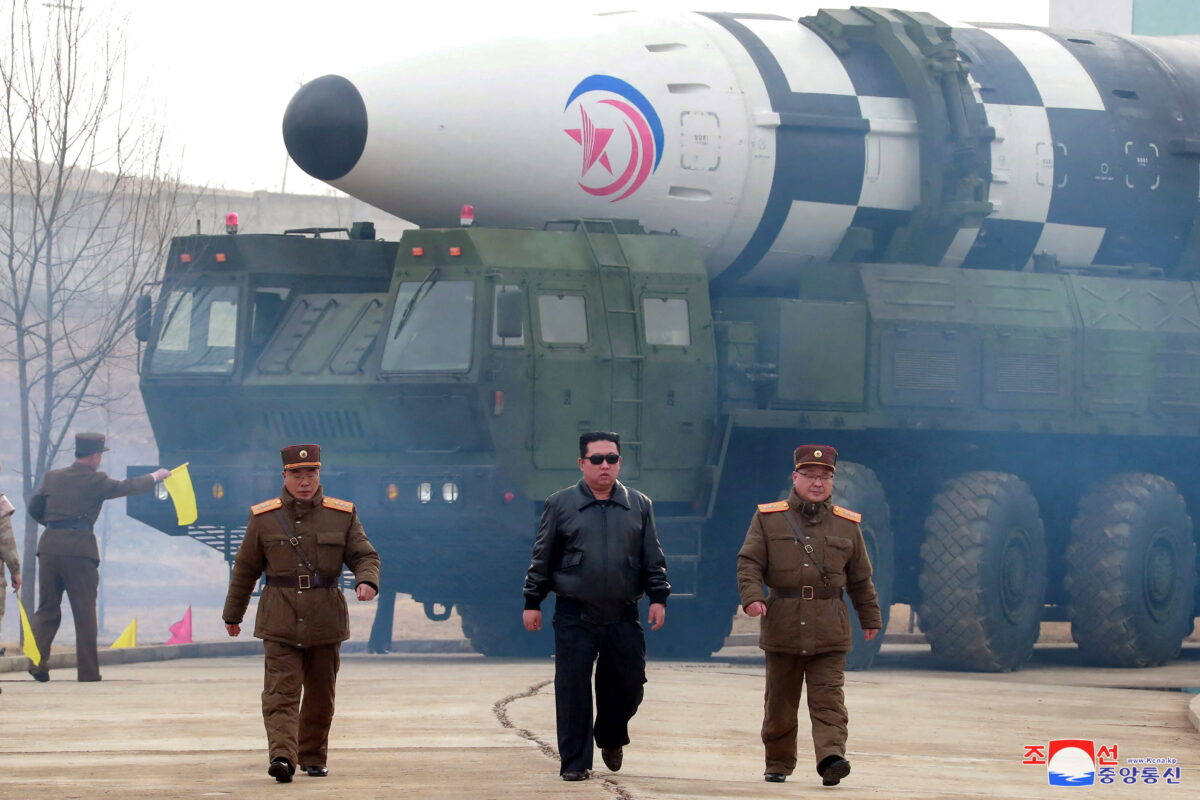
The Hwasong-15 projectile flew 596 miles (960 kilometers) at a maximum elevation of 2,796 miles (4,500 kilometers) when it was launched in 2017, while the recent ICBM took a trip 681 miles (1,090 kilometers) at a maximum altitude of 3,905 miles (6,248.5 kilometers).
The ministry thinks that North Korea’s deceptiveness regarding the launch of Hwasong-17 was likely an attempt to make up for a fallen short launch on March 16 that South Korea declared exploded overhead after liftoff.
It included that Pyongyang may have meant to trick its opponents right into believing it possessed sophisticated ICBM technology to strengthen its picture as an armed forces power and enhance its utility in future arrangements.
North Korea has actually conducted greater than 10 projectile examinations this year, including 2 launches of reconnaissance satellites on March 4 as well as Feb. 27, which the United States claimed included a new ICBM that Pyongyang initially revealed throughout an armed forces ceremony in 2020.
H/T The Epoch Times


